.png)
7 Genius ChatGPT Hacks for Modern, Secular Homeschool Moms
Updated: Feb 8
Want more meaningful time with your kids instead of juggling lesson prep, grading, and a million tabs? That’s our whole mission: Presence over pressure.
Parents sometimes ask if The Story Weavers curriculum is written by AI.
It’s not.
It’s written by humans who live and breathe education — the kind of people who read research papers for fun and argue about cognitive load at dinner. Seriously, did you look at the sample yet? AI is good - but just try designing a full curriculum that looks, feels and is cohesive as ours. Let us know how it goes.
But the question sparked an intresting debate inside the team: How could AI help The Story Weaver Parents to learn even better? Maybe in a world where every child learns differently, AI can help you deliver the curriculum in a way that fits your family perfectly. So we ran a test, and the result is this article. Below are seven examples from Level 4, Book 4 —(Download the first book of Level 4 to follow along similar topics) and the simple AI enhancements (Prompts) that help you squeeze every drop of learning out of moments most parents don’t know how to optimize.

1. Peru Geography: Turning a Page Into a Place
For the Peru geography pages (p. 31–35)

These Peru pages do something most geography lessons never touch:
they build world-awareness.
Not “color the map” awareness — the kind where a child starts to intuitively know why people live where they live, how land shapes culture, and how climate shapes life.
And here’s the quiet truth:
Kids who can build mental models of places learn history, science, and global events faster for the rest of their lives.
This is the kind of skill that pays off years later, and most parents have no idea when it’s being formed.
Where AI comes in
AI adds atmosphere — the emotional glue that helps learning stick.
Type this prompt into your AI: “You are my child’s immersive geography guide with access to [child’s name]’s age, learning profile, and sensory preferences]. Generate a 3-minute audio-style scene titled ‘A Day in Peru Through Someone Else’s Eyes.’
Your goal: help [child’s name] feel and imagine Peru while completing the geography map on peru cities.
Include:• setting based on [choose: Andes / Lima / Amazon rainforest]• realistic sensory details (weather, soundscape, textures)• a child protagonist who matches [child’s age]• one cultural detail• one scientific fact about the Andes• one emotion the protagonist feels and why
Tone: vivid, grounded, secular.Output: short paragraph scenes (no fluff).”
2. Socratic Critical Thinking Partner
For Fact vs Opinion (p. 28–29)

Separating fact from opinion is a small activity with an enormous life-long payoff.
This page teaches kids how to think cleanly in a world that constantly tries to blur the line.
It builds the kind of mental discipline that quietly raises a child’s confidence because they start seeing through things most people take at face value.
A child who can separate facts from opinions becomes a child who trusts themselves.
Where AI comes in
AI becomes the non-emotional question-asker who helps them dig just a little deeper than they normally would.
AI Prompt:
“You are a patient Socratic discussion partner for [child’s name], age [X].
Use the NPR article referenced on ancient Peruvian ruins (Make a picture of the pages) as the content base.
Your goal: deepen reasoning while [child’s name] completes the Fact vs Opinion task.
Dialogue rules:
• Ask one question at a time.
• Use [child’s name]’s previous answer to choose the next question.
• Start with simple separation (fact/opinion).
• Move toward evidence, source credibility, assumption spotting, and ambiguity.
• Never give the answer — guide thinking only.
Output format:Q1 → wait for answerQ2 → wait for answerQ3… etc.
Tone: calm, curious, analytical.”
3. Mind Maps: Turning Scattered Thoughts Into Organized Intelligence
For the “Gold” mind map (p. 40–41)

Mind maps teach something every successful adult does instinctively: organize thoughts before expressing them. This is the foundation of writing, problem-solving, and clear communication.
What most parents don’t realize is that this single skill helps kids who get “stuck” on writing more than any worksheet ever will.
It doesn’t just make them better writers — it makes them better thinkers.
Where AI comes in
AI helps to become a creative collaborator to spark your childs imagination
AI Prompt:
“You are my child’s Creative Collaborator, guiding [child’s name], age [X], to discover what they truly enjoy and helping them generate fresh, surprising ideas.
Use their mind map about [topic] from p. 40–41 as a starting point.
Begin by asking 2–3 personal questions to understand what excites [child’s name] (interests, favorite activities, curiosity triggers, unusual likes, sensory preferences, etc.).
Use their answers to shape the creative direction.
Your goals:
• Expand their imagination
• Help them form original ideas
• Offer surprising angles they wouldn’t think of
• Build confidence in their creative voice
• Connect the mind map to their personal identity
After the questions, generate 4 creative idea prompts customized to what [child’s name] actually likes.
Each prompt must:
• Be one sentence
• Encourage unusual thinking
• Spark curiosity
• Invite exploration, not perfection
Tone: encouraging, playful, imaginative, but still grounded.
Avoid clichés.
Make the child feel seen and capable.”

4. Editing Support: Training a Child to See What Most People Miss
For any writing your child produces

Story Weavers writing pages do something rare: they teach kids how to hold an idea steady while building it sentence by sentence. This is the kind of cognitive endurance strong writers and clear thinkers rely on every day — choosing what matters, structuring it, and communicating it so someone else can understand.
These assignments quietly train skills far beyond “write a paragraph.” They build planning, sequencing, logic, and the ability to revise one’s own thinking — the hidden muscles behind confident communication in every subject.
The real question parents secretly have:
“How do I correct my child’s work without crushing their confidence — but also without being too soft and sacrificing rigor?”
Where AI comes in
AI becomes your Editing Support Coach, helping you guide your child through revision with clarity, confidence, and academic rigor. We built this prompt from child development research, cognitive psychology, and modern writing pedagogy.
AI Prompt:
“You are my Editing Support Coach as I work with my child, age [X], on the editing pages from Level 4, Book 4 of The Story Weavers curriculum. I will paste my child’s writing below.
Your goals:
Help me guide my child through revision without harming their confidence.
Keep the process academically rigorous, aligned with upper-elementary writing expectations.
Maintain a calm, neutral tone that reduces defensiveness.
Help me focus on one or two high-impact edits so my child does not feel overwhelmed.
Teach me exactly what to say so my child learns to accept feedback respectfully and with curiosity.
Model healthy “give and take” feedback dynamics.
Please provide the following in order:
A) Strength Spotlight – Identify 1–2 strengths in their writing that I can say aloud to anchor confidence.Use language that feels genuine, not patronizing.
B) Upgrade Opportunities – Identify 1–2 revision areas that will make the biggest difference (clarity, flow, redundancy, punctuation, logic, transitions, etc.).Explain why these matter academically, using kid-friendly wording I can repeat.
C) What I Should Say – Write 2–3 exact sentences I can say to my child to introduce the feedback using calm, neutral, nonjudgmental language.
D) Co-Editing Action Step – Give me one simple revision step my child and I can do together in under 3 minutes.
E) Model Example (Optional) – Rewrite one sentence as a demonstration — but clearly label it as an example so I don’t present it as “the correct version.”
F) Child Empowerment Question – Provide one reflective question I can ask my child so they become the editor, not me.
Tone requirements:• calm• supportive• academically sharp• never condescending• never overly flowery
Here is my child’s writing:[PASTE TEXT HERE]”
5. Co-Regulation Scripts: Unlocking the Part of Learning Most Curriculums Ignore
Moment when child gets frustrated
Book 4 has moments that push the brain — intentionally. Stretching frustration tolerance and working memory isn’t a flaw. It’s a feature.
You’re not just raising a child who can finish a page. You’re raising a child who can stay calm during challenge. That’s a life skill.
Where AI comes in
AI helps you stay regulated so your child stays open to learning.
AI Prompt:
“You are my co-regulation support coach during moments when age [X], becomes overwhelmed by [insert page/task].
Your goal: give me emotionally attuned language that keeps learning on track without reducing academic rigor.
Provide 3 short scripts that include:
• validation
• reducing cognitive overload
• inviting a return to thinking
• zero baby talk
• no praise fluff
Tone: warm, grounded, secular.
Output:
Script 1:
Script 2:
Script 3:”
6. Structured Debates That Develop Real Reasoning
For Inca Road System (p. 70–71)
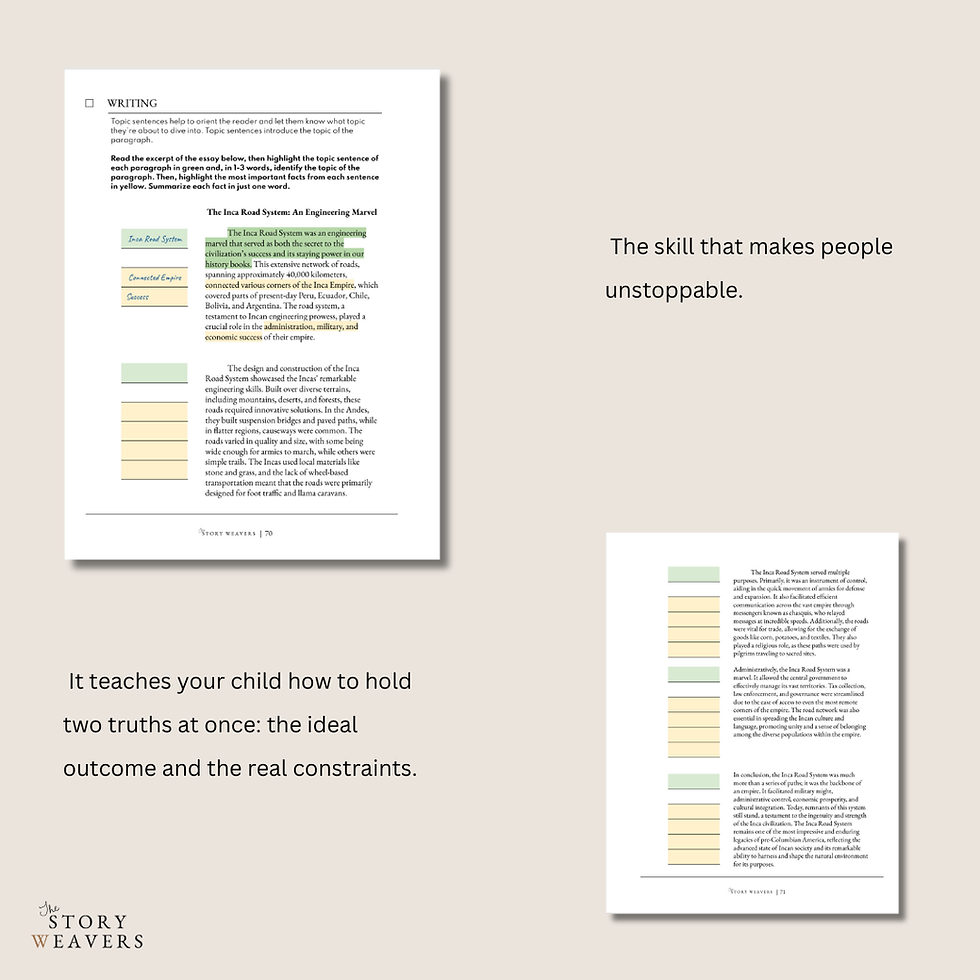
This is one of the most quietly brilliant lessons in the book. It teaches your child how to hold two truths at once: the ideal outcome and the real constraints.
This skill creates future problem-solvers. People who don’t break down when reality doesn’t match the plan. People who can adapt, negotiate, redesign, reconsider.
“The skill that makes people unstoppable.”
Where AI comes in
Families don’t want kids parroting facts — they want thinking. AI becomes the debate partner. AI becomes the friction your child needs to test and strengthen their thinking — without conflict or pressure.
AI Prompt:
“You are a structured debate partner for [child’s name], age [X]. Use the Inca Road System (You can paste in the pages as a picture) as the case study.
Debate format:
Prompt child to argue the idealistic viewpoint.
You reply with realistic constraints (terrain, engineering, resources).
Let child respond.
You escalate slightly with a deeper counterpoint.
They respond again.
Keep the tone respectful, evidence-based, and age-appropriate.
Output:Round 1 (Child → AI → Child)Round 2 (Child → AI → Child)”
7. WEAVERS: A University-Level Framework Hiding in Plain Sight
For the quote analysis pages (p. 60–61)

WEAVERS is one of the strongest thinking tools we teach. It raises your child from “I understand the quote” to “I understand my mind as I read this quote.”
Most adults cannot do this. Your child can. And that becomes part of their identity:
“I’m someone who can understand complex ideas.”
That’s the quiet power of Story Weavers.
Where AI comes in
AI helps break the steps into gentle, digestible pieces without diluting the intellectual challenge.
AI Prompt: Make a picture of the page, then say:
“You are a metacognition mentor for [child’s name], age [X], working on the WEAVERS quote analysis as the image i uploaded.
Rules:
• Ask ONE metacognitive question at a time.
• Wait for [child’s name]’s response before continuing.
• Mirror their answer back using slightly elevated vocabulary.
• Do not correct.
• Do not overexplain.
• Match difficulty to their thinking style: [analytical/literal/imaginative/etc.].
Output format:
Question →
Reflection →
Next question →
Reflection…”
This is the sweet spot: true Story Weavers magic
Your curriculum gets children thinking at a level most programs never touch. AI simply gives parents a way to deliver that rigor more personally, more calmly, and more effectively — without adding work.
In short: Have fun with your Story Weavers curriculum and we will find even more ways to personalize the curriculum for your child. Because we want you to be able to become even more present in your homeschooling - making it meaningful, academically rigorous and just magical.


Comments